Archive
June 5, 2026
Beyond Compliance: How early-stage climate companies can turn ESG into competitive advantage
.jpg)


European sustainability regulations create unintended barriers for small and mid-sized enterprises seeking capital. By understanding these frameworks, founders can not only reduce friction, but add resilience into the foundations of their business at exactly the moment it matters most.
The context has shifted. The 2020-2025 cycle was defined by the rise of climate tech, with capital and regulation both moving, however imperfectly, in the same direction.
Today, something more turbulent is underway. Supply chains are being redrawn by geopolitical fragmentation. Energy and food security have become questions of national sovereignty. Climate volatility is no longer just an environmental concern; it is an economic risk multiplier that is repricing assets, disrupting harvests, and straining infrastructure across emerging markets in real time.
For climate SMEs in the Global South, this means operating under a compounding set of pressures: rising input costs, currency volatility, and narrowed access to the European capital that many of them depend on for growth.
A new focus on sovereignty and resilience in Europe is shifting capital to local solutions, including defense-tech. EU regulations create another strain. The surge in global sustainability frameworks, most notably, Europe’s Sustainable Finance Disclosure Regulation (SFDR), Corporate Sustainability Reporting Directive (CSRD), and Carbon Border Adjustment Mechanism (CBAM), serve an important purpose: bringing transparency to capital flows and directing more investment toward ESG-conscious actors.
But these regulations were not built with early-stage startups in mind, and even less so for those operating in emerging markets. As a result, they have created a real, if unintentional, barrier for Global South founders seeking capital from European investors, where reporting requirements and ESG and impact expectations are becoming more stringent. As climate impact investors backing SMEs across these markets, we see this tension daily.
EU REGULATION: A REAL AND UNINTENTIONAL BARRIER
Take a seed-stage climate data company in our portfolio in Africa. When we ran our annual reporting exercise, it flagged gaps: no formal ESG policy and limited governance documentation. On paper, the business looked underprepared. In practice, the team had a clear impact thesis, had completed a carbon footprint assessment, and was already thinking carefully about its environmental footprint. The issue was not what they were doing, but how it was being captured.
Or consider another seed-stage company in Africa in our portfolio. They had an ESG policy in place and understood their impact deeply. But when it came to articulating that to European investors, the story wasn’t landing. The data existed but the challenge was translating it into the language investors expected. What they needed was not more compliance, but better framing.
These are not edge cases. They reflect a structural mismatch between frameworks built for mature markets and the realities of building a climate company in an emerging one. Much of this barrier can be reduced. The founders who navigate it best are not those who comply most efficiently. They are the ones who understand what these frameworks are actually asking, and use them deliberately to build stronger businesses.
This requires, first, demystifying the expectations—what catchphrases like “theory of change” and “impact KPIs” actually mean, what acronyms like SFDR and CSRD actually require, and what investors are realistically looking for at each stage of a company’s growth.
DISTINGUISHING BETWEEN ESG AND IMPACT
It also requires a clear-eyed distinction between two concepts that founders, and frankly, many investors, routinely conflate: ESG and impact.
ESG focuses on risk management and internal operations. Essentially, how a company does what it does. It covers the environmental, social, and governance factors that affect operational health and revenue streams: compensation policies, board composition, diversity and inclusion, anti-corruption measures, human rights practices, supply chain management. ESG is the underlying infrastructure that makes a company more durable.
In an environment where geopolitical shocks and climate events can cascade through supply chains with little warning, getting this right is not an administrative exercise. It is a competitive asset, and increasingly, a prerequisite for accessing European capital.
Impact, on the other hand, addresses the positive outcomes generated by the core product or service; what the company does, not how it operates. Impact work is only meaningful for companies delivering a net-positive product or service, where measurable non-financial benefits can be converted into business value: attracting customers, retaining talent, staying ahead of regulation, and accessing capital from investors who are specifically looking for proof of positive outcomes.1
In practice, ESG tends to end up with the HR manager or compliance officer, while impact work lands with the CPO or CEO. This is roughly right, but both need intentional ownership, and neither should be treated as a quarterly reporting exercise rather than a genuine operating discipline.
For climate SMEs in emerging markets, the underlying impact case is often structurally strong. These are businesses addressing populations that are most exposed to climate risk, frequently delivering co-benefits across climate, livelihoods, and health simultaneously. The harder challenge is not the impact itself; it is making that case in language European investors recognize, with data they trust.
The question founders most frequently ask us is: where do I start, and what is realistic at my stage? The honest answer is that the bar is rising faster than most early-stage companies can keep up with, and that is especially true in emerging markets. What matters is not ticking every box but building the right habits and systems from the start. At the end of this article, we offer a practical roadmap to help founders see where investor expectations are heading and make deliberate choices about what to prioritize at each stage.
TREAT YOUR CONSTRAINTS AS PART OF YOUR NARRATIVE
For founders who are resource-constrained, which is most of them, the instinct is often to defer ESG and impact work until there is more time, more money, or more team members. That is understandable. It is also a mistake. Focus on what is material to your sector and business model, not on producing comprehensive reports that nobody will read carefully. Use free tools: the B Impact Assessment, the GHG Protocol calculators, IMP’s five dimensions. Build simple digital systems for data collection from the beginning; manual spreadsheets do not scale and create assurance problems later. Be transparent about gaps rather than papering over them. Experienced investors will see through it immediately.
Most importantly, treat your constraints as part of your narrative, not as something to apologize for. Founders building climate solutions in markets defined by rising prices, infrastructure gaps, and climate vulnerability are not operating at a disadvantage relative to their counterparts in more stable environments; they are building leaner, more adaptive businesses, closer to the problems that matter most. That is a story worth conveying clearly.
The ESG and impact frameworks that can feel like an external imposition are—used well—precisely the tools that make that story legible to the investors who need to hear it.
The companies that will define the next decade of climate tech—what we call Earth Tech, a category broader than climate tech alone—, the businesses that enable humanity and the planet to thrive together, will not be those that complied most diligently with European regulation. They will be those who built operational resilience and impact credibility from the ground up, in conditions that demanded it. The question is not whether to engage with these frameworks. It is how to use them to build the company you want to become.
A ROADMAP TO NAVIGATING ESG AND IMPACT
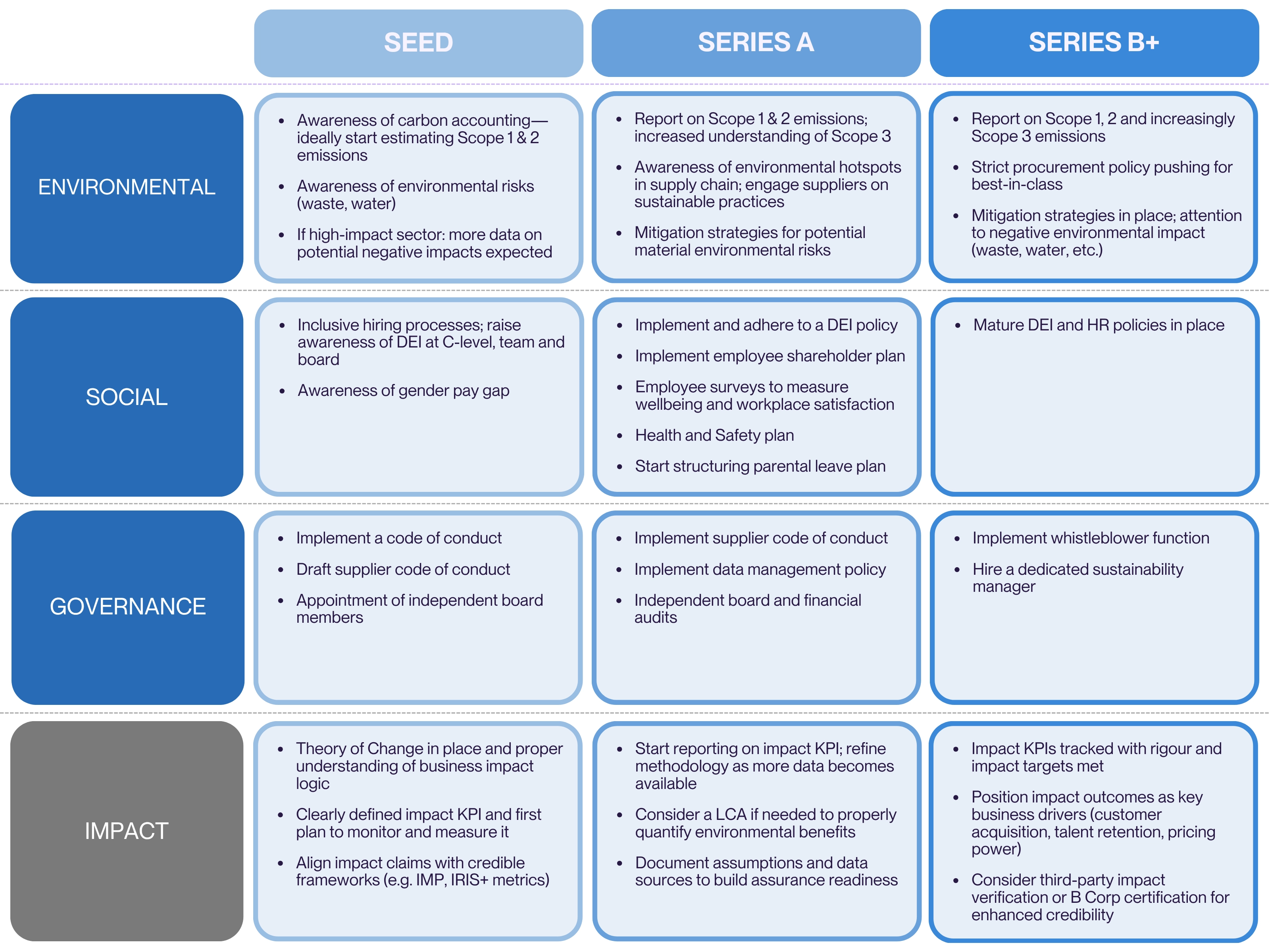
The framework below reflects where investor expectations are moving, not necessarily where they are today. We share it not as a checklist, but as a map so founders can see the direction of travel and make deliberate choices about what to prioritize at each stage.
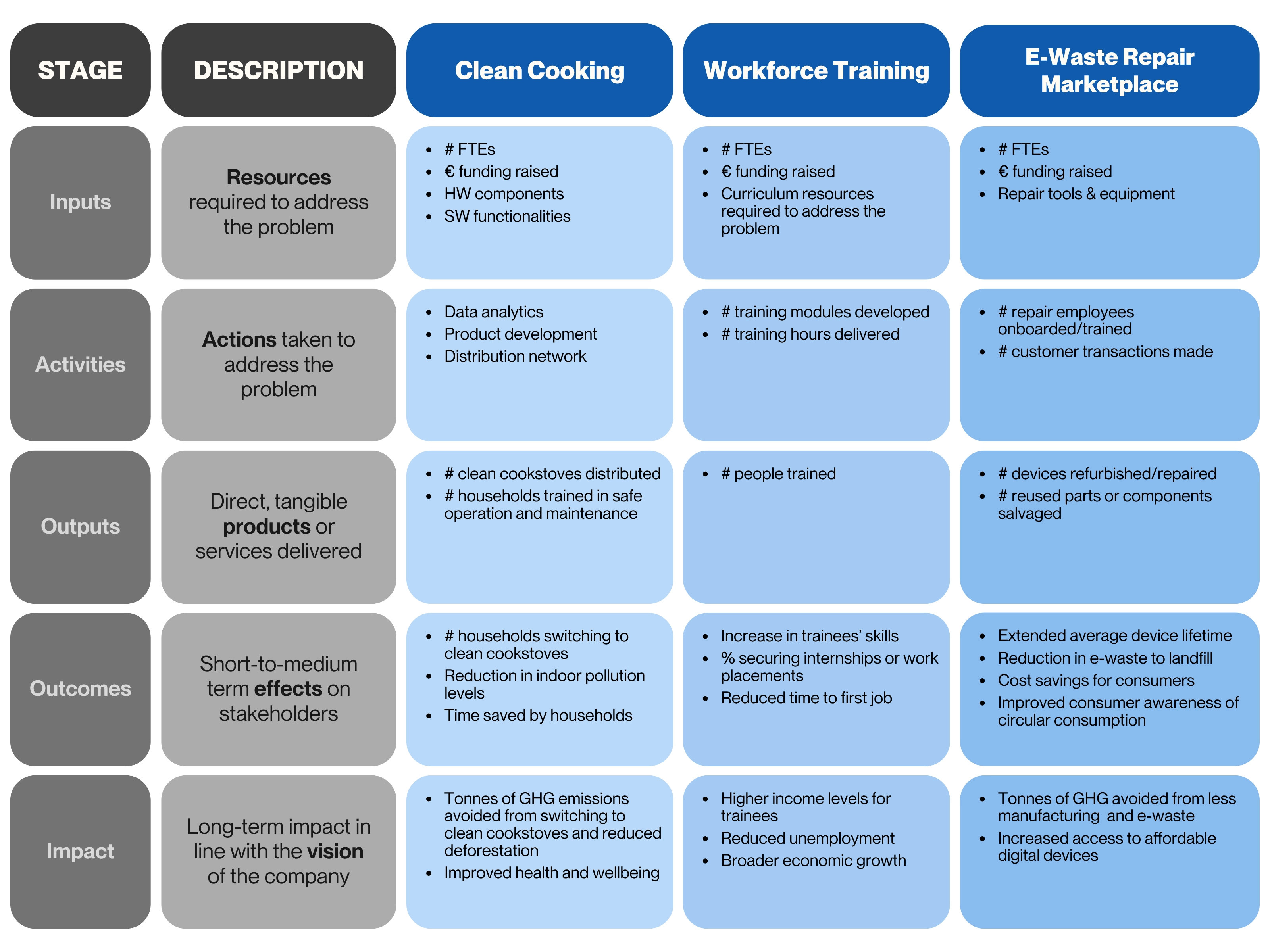
One of the most accessible entry points is to establish your startup’s own impact logic through a Theory of Change exercise, which helps break down the value your business generates at each stage and how that value ultimately translates into the impact you seek to achieve.
Step 1: Define your impact KPI so you have a clear North Star guiding your efforts.
Step 2: Document the inputs, activities, and outputs. This stage is often straightforward, as most of this data is readily available.
Step 3: Identify the data, proxies, benchmark calculations, or other methodologies needed to accurately convert outputs into outcomes, and ultimately outcomes into impact. This is where the real work happens.
Step 4: Consider conducting a Life Cycle Assessment (LCA) if you need a cradle-to-grave evaluation of your product or service’s environmental footprint, especially when compared to more polluting alternatives.