

Past Events
April 9, 2026
RECAP - Pioneering South Asian Impact Bonds to Unlock SME Capital

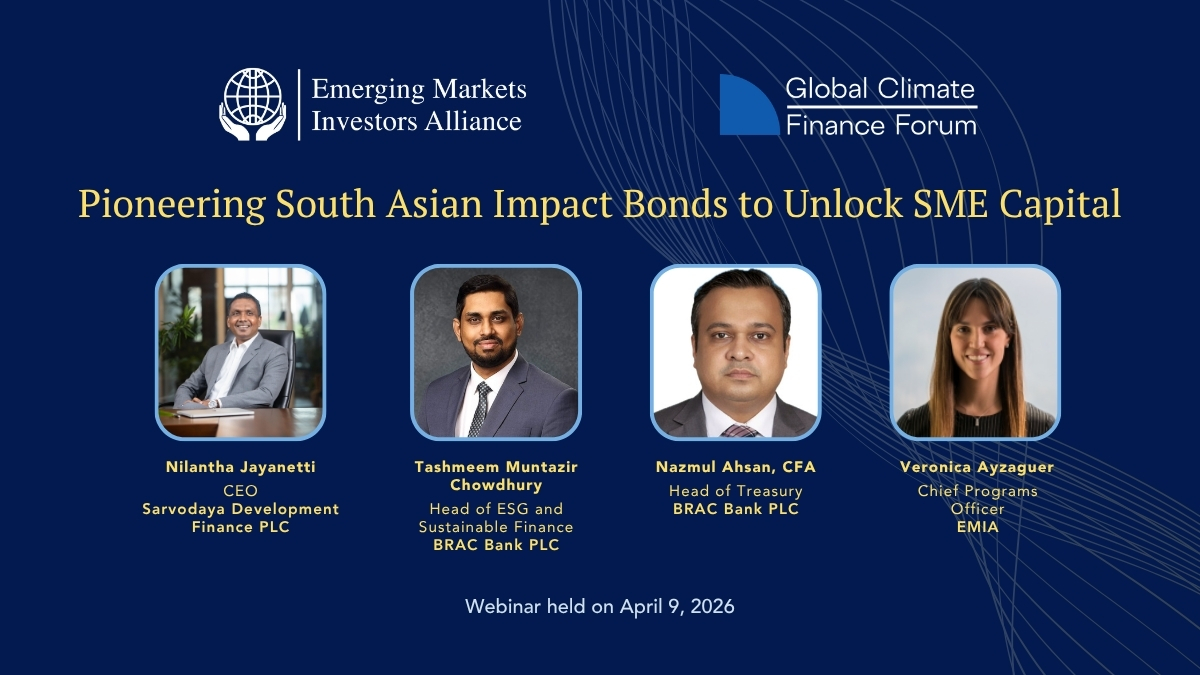
At our recent webinar, “Pioneering South Asian Impact Bonds to Unlock SME Capital,” co-hosted with the Emerging Markets Investors Alliance (EMIA), speakers from BRAC Bank in Bangladesh and Sarvodaya Development Finance (SDF) in Sri Lanka explored how local financial institutions are using thematic bond issuances to expand financing for underserved small and medium enterprises (SMEs) while strengthening credibility in domestic impact capital markets.
The discussion began with the broader financing challenge facing SMEs in emerging markets. As highlighted during the session, SMEs account for a significant share of locally developed climate and development solutions, yet continue to receive only a small fraction of available capital. Against this backdrop, presenters emphasized that bond markets can serve not only as a source of funding, but also as a mechanism to connect investors to high-impact SME portfolios in ways that align with international standards and build market confidence.
Representatives from BRAC Bank, Tashmeem Muntazir Chowdhury (Head of ESG and Sustainable Finance) and Nazmul Ahsan, CPA (Head of Treasury) described the issuance of Bangladesh’s first social bond as a natural extension of the bank’s long-standing focus on financing the country’s “missing middle”: cottage, micro, small, and medium enterprises that are often underserved by traditional financial institutions. They situated the bond within Bangladesh’s wider social context, pointing to persistent financing constraints affecting informal workers, youth, women entrepreneurs, and agricultural producers. To structure the issuance, BRAC Bank developed a framework aligned with the ICMA Social Bond Principles, covering categories including SME finance, gender-based financing, agriculture value chains, affordable housing, healthcare, and water and sanitation. In the absence of a clear local framework for social bonds, external validation was critical: BRAC obtained a second-party opinion from S&P Global and drew on lessons from issuers in other emerging markets. The bond reached 98% subscription, attracting a mix of retail, corporate, and NGO investors and demonstrating demand for fixed-income products linked to measurable social impact.
Mahesh Jayanetti, CEO of Sarvodaya Development Finance, explained how Sri Lanka’s first sustainability bond was rooted in the mission of the broader Sarvodaya Shramadana Movement, one of the country’s longest-standing community development institutions. The bond combines social and green financing objectives, supporting renewable energy, clean transportation, women’s empowerment, food security, and agricultural modernization. SDF emphasized that the framework aligns with ICMA Green Bond Principles, Social Bond Principles, and Sustainability Bond Guidelines, and that impact is monitored through digitally enabled reporting systems tracking indicators such as renewable energy generation, jobs supported, loans to SMEs and microenterprises, and women entrepreneurs reached.
Across both case studies, a clear theme emerged: pioneering bond issuances in frontier and emerging markets require more than investor demand. They also depend on regulatory engagement, market education, credible reporting, and institutions with the internal capacity to originate and track eligible assets. Both issuances also incorporated measurable KPIs — from jobs created to renewable energy generated — helping mitigate greenwashing risks, establish a verifiable track record of impact, and appeal to international capital. Together, BRAC Bank and SDF illustrated how innovative bond structures can help move SME finance from concept to execution while laying the groundwork for deeper, more transparent impact capital markets in South Asia.