


Past Events
July 14, 2026
RECAP - GCFF Workshop at London Climate Action Week: Science, Financial Innovation, and Action
THE DISCONNECT BETWEEN CAPITAL AND CARBON
Project Drawdown revealed a critical disconnect: capital (whether philanthropic, venture, or public) is not being allocated in proportion to emissions sources.
- Climate Philanthropy (USD 6-8 billion annually in 2021): 66% flows to energy and transportation, while only 9% flows to food, agriculture, and land use (AFOLU), despite this sector representing nearly 19% of emissions.
- Venture Capital: 32% flows to energy, yet only 3% flows to agriculture and food and another 3% to buildings, which emits ~22%.
- The U.S. Inflation Reduction Act: Allocates 66% to energy and 14% to transportation, leaving agriculture with just 3% and industry with 8%.
According to James Gerber, this misalignment shows that capital flows toward sectors with more mature business models (energy), but ignores sectors with enormous mitigation potential and a need for financial innovation (agriculture, land use, buildings).
BECAUSE, REALLY, WHAT ARE GOOD CLIMATE SOLUTIONS?
James Gerber presented a classification that surprised the audience: climate solutions are not always what they seem.
Project Drawdown classifies solutions into four categories:
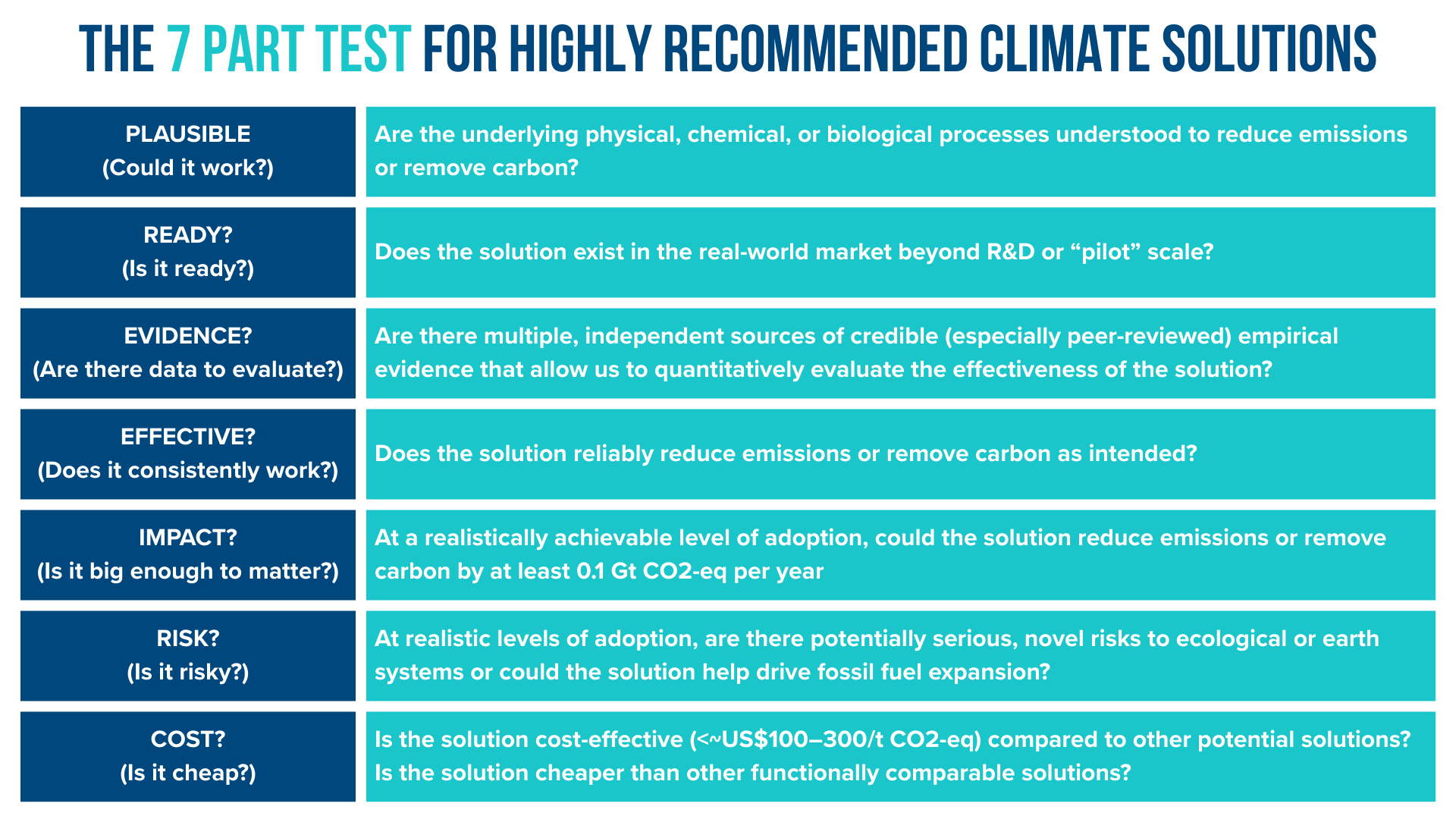
- Highly Recommended: Solutions that meet all criteria and have significant global impact.
- Example: Utility-scale solar photovoltaics (potential impact of 1.58 Gt CO₂-eq/year).
- Worthwhile: Solutions that can contribute to climate change mitigation, but do not reach the scale required to be considered major global climate solutions.
- Example: Electric irrigation pumps.
- Keep Watching: Solutions that have potential but are not yet available, effective, or reasonably priced.
- Example: Feed additives to reduce livestock methane.
- Not Recommended: Approaches that are not scientifically plausible or present high risks.
- Examples: Vertical farms, direct air capture, and grass-finished beef, the latter due to land-use inefficiency and emissions.
WHY ISN'T EVERYONE INVESTING IN CLIMATE SOLUTIONS?
In the midst of a historic heat wave in London and half of Europe, the Solar Impulse Foundation’s presentation reaffirmed the conviction of the organization founded by Bertrand Piccard in 2017: protecting the environment can be profitable.
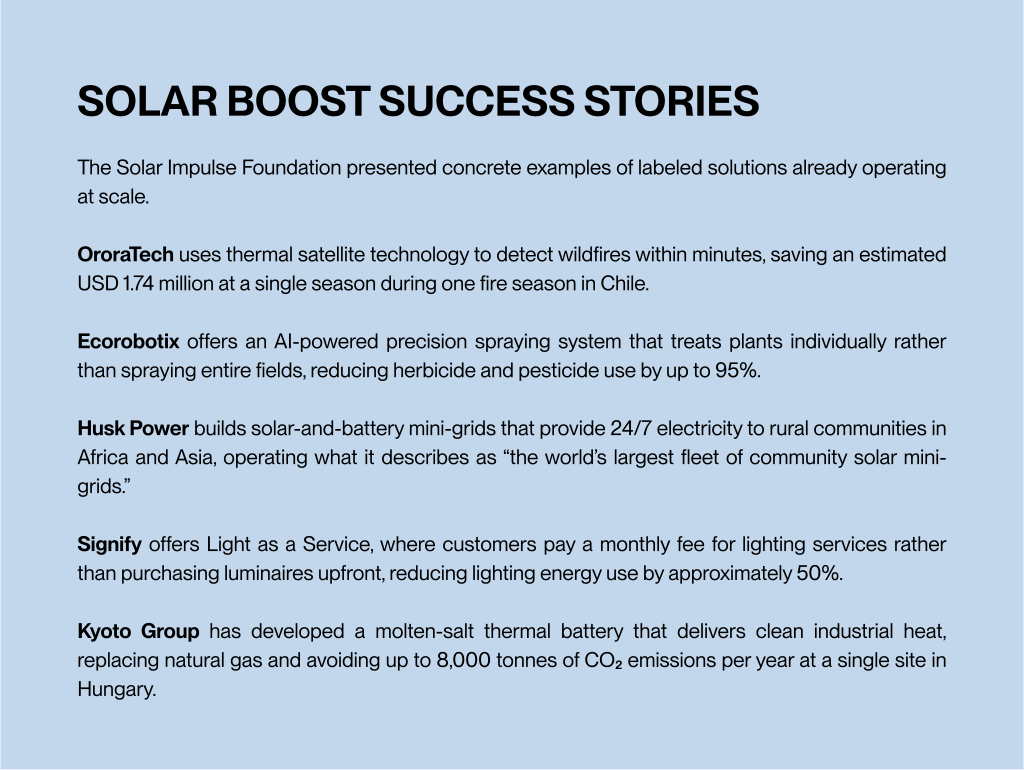
The Foundation has developed a rigorous label based on three criteria: feasibility (Does the solution work and can it scale?), environmental impact (Does it beat business-as-usual?), and profitability (Does the customer save money by adopting it?). The evaluation process is free for applicants, relies on a pool of over 350 independent experts, and takes about three to four weeks.
Since its inception, Solar Impulse Foundation has labeled over 1,600 solutions across nine sectors, including energy, industry, buildings, agriculture, mobility, and waste. These labeled companies have raised more than EUR 12 billion in equity since 2017, proving that the portfolio is not a theoretical exercise, but a working collection of market-ready technologies.
Despite the viability of these solutions, Robin Henri identified structural barriers to scaling them. Investors often perceive new technologies as risky, traditional capital expenditure models do not fit every market, and projects are frequently too small or dispersed to attract debt financing.
For the Solar Impulse Foundation, the problem is not a lack of credible climate solutions, but a lack of financial structures that can make them accessible at scale.
THE OPPORTUNITY OF EMERGING MARKETS
Currently, more than 80% of climate finance is concentrated in developed countries, and across sectors, energy has achieved the greatest institutional scale. This misalignment between available capital and global needs creates market inefficiencies that, when properly identified and addressed, can offer significant investment opportunities with high potential for structural returns, explained Carla Orrego in her presentation.
The Climate Policy Initiative identifies three levels of inefficiencies that hinder the growth of climate finance: macro, sectoral, and project-level. The main barrier is not a lack of appetite from commercial investors, but rather that existing financial structures do not meet their risk-return and liquidity requirements. The myth that investors avoid climate finance for ethical reasons is being debunked: what they reject are instruments that don't align with their financial mandates.
Therefore, the key solution is financial innovation. Orrego explained that this does not imply inventing exotic new products, but rather combining traditional financial instruments with appropriate risk-mitigation mechanisms.
Half of all climate finance flows in emerging markets and developing economies (EMDEs) are directed toward energy, with USD 979 billion allocated to mitigation in the energy sector, though financing needs are estimated at USD 3.86 trillion by 2030. Solar photovoltaic deployment is leading this growth, supported by high irradiance and falling costs, particularly in Sub-Saharan Africa and countries such as Pakistan and South Africa. However, financing for storage and grids has not kept pace, creating an investment niche for hybrid solar-plus-storage systems.
The agriculture, forestry, and other land-use (AFOLU) sector presents the largest financing gap in emerging and developing economies, despite representing a major source of emissions and supporting over one billion livelihoods. Forest finance nearly tripled to USD 1.3 billion in 2023, but remains minimal overall.
THREE INVESTMENT THESES
Climate Policy Initiative included three cases that exemplify these investment theses:
1. Climate Investor One (Infrastructure): A fund that invests in the development, construction, and refinancing of renewable-energy projects across EMDEs (Latin America, Africa, and Asia). Its three-component structure—development, construction through blended finance, and refinancing—de-risks capital at each stage.
2. Green FIDC (Distributed Generation): An asset-securitization vehicle in Brazil that invests in future cash flows from distributed generation and energy efficiency contracts in the commercial and industrial (C&I) sector. It functions as a synthetic fixed-income product with senior and subordinated tranches, allowing for the aggregation of small-scale projects and providing liquidity.
3. Responsible Commodities Facility (Supply Chains): A debt fund in Brazil that provides loans to agricultural producers in exchange for future offtake agreements with international retailers. Access to financing is conditional on compliance with no-deforestation requirements, thereby aligning economic incentives with environmental sustainability.